
aeroforms
Data Analysis
Data Visualisation
Research & Strategy
UI/UX Design
Modelling olfactory cartographies of Japan
Figma, Python, Three.js, AfterEffects
Aeroforms is a computational framework that maps the scentscapes of Japan, combining environmental data, chemical literature, and cultural archives to visualize how lived olfactory experience diverges from the air we actually breathe.
As part of a team of two with backgrounds in computer science, biology, design, and engineering, the work develops a reproducible methodology for modelling scent across all Japanese prefectures and translating those models into interpretable visual narratives.
The Problem
When memories of place diverge from the air
Japan’s Ministry of the Environment designated the “100 Scents of Japan” to preserve fragrances tied to regional heritage, local industry, and national identity.
At the same time, industrialization and shifting land use are reshaping the volatile organic compounds (VOCs) that actually define today’s atmosphere.
-
Cultural scent narratives emphasize cedar forests, green tea, coastal air, and seasonal blossoms.
-
Environmental monitoring reveals growing contributions from industrial pollutants and anthropogenic emissions that rarely appear in official scent lists
Building a computational scent taxonomy
SCENT TAXONOMY
Adapts and extends existing scent wheels to define categories such as floral, fruity, vegetal, earthy, smoky, woody, chemical and anamolic
Maps descriptors from the “100 Scents of Japan” and primary VOC literature into this taxonomy to enable comparison across sources.
ENVIRONMENTAL AND CULTURAL DATASETS
Integrates land use data (forests, grazing land, rice, wheat, fruits, vegetables) from Japanese ministries with industrial emission inventories and pollutant indices
Normalise values by prefecture area so high population regions do not automatically dominate scent composition
CHEMICAL AND VOC LITERATURE
Extracts odor threshold values and scent associations for volatile compounds from peer‑reviewed studies and VOC databases.
Constructs a lookup table linking each compound to one or more scent categories with weighted contributions.
Research
What scents are we truly passing down to the next generation, and where do cherished olfactory landscapes sit at risk?
FEATURE 1
Scent Taxonomy
FEATURE 2
Detailed Scent Breakdowns
National
Scent Map
FEATURE 3


To move from narrative descriptions to measurable olfactory profiles, the project constructs a multi‑layered data pipeline:


Final Design

From VOC tables to scent landscapes
The project places equal emphasis on scientific rigor and communicative clarity, translating high‑dimensional chemical data into visual forms that can be read at a glance.
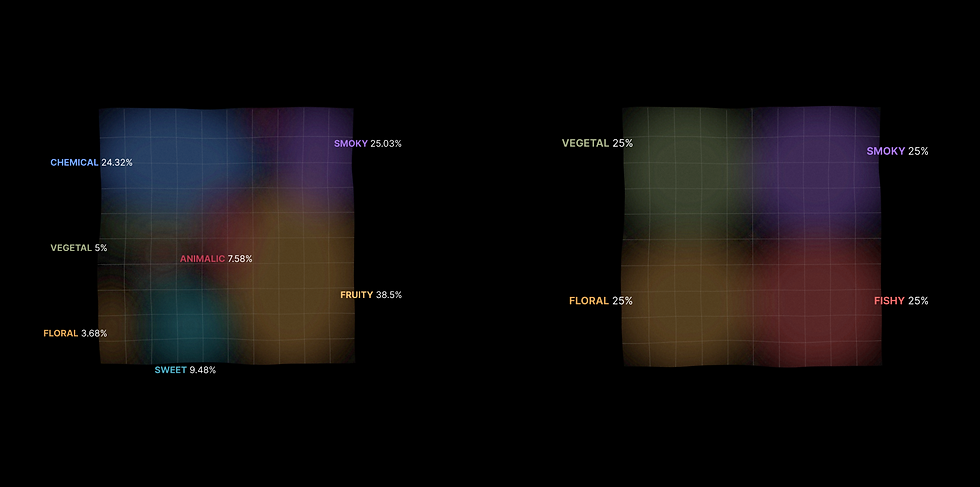
FEATURE 1: MESH-GRID SCENT COMPOSITIONS
Each prefecture’s composite scent profile is rendered on a mesh grid where colour and area encode the proportional contribution of each category.
This allows viewers to see, for example, how a region’s “floral” narrative coexists with a strong underlying chemical or smoky signature.

FEATURE 2: SCENT DIVERGENCE MAPS
National maps compare modelled compositions to culturally celebrated “scents to pass down to the next generation.”
Divergence layers highlight where public perception underestimates pollution or where cherished olfactory landscapes may be more fragile than expected.
FEATURE 3: DETAILED BREAKDOWNS
Hover interactions reveal predominant scents and detailed breakdowns per prefecture, such as “Hokkaido – 37‑element profile: floral 50, vegetal 35, fruity 10.”

FEATURE 4: INTERACTION CONCEPTS
Toggle controls let users switch between agricultural, industrial, and combined views to see how different systems shape the same geography.

_edited.jpg)
Key Findings
Across Japan, the model surfaces patterns that are difficult to see in traditional environmental reports:
-
Regions celebrated for natural or agricultural scents often carry a substantial chemical baseline, especially where industrial and urban land uses intersect.
-
Some prefectures with strong cultural narratives of purity or seasonality show higher modeled contributions from smoky or chemical categories than from floral notes.
-
At the national scale, the cumulative scent profile skews more heavily toward chemical and smoky categories than the romanticized catalog of 100 Scents suggests.
These divergences become starting points for conversations about environmental justice, heritage preservation, and the politics of what is made visible (or smellable) in public discourse.
_edited.jpg)